
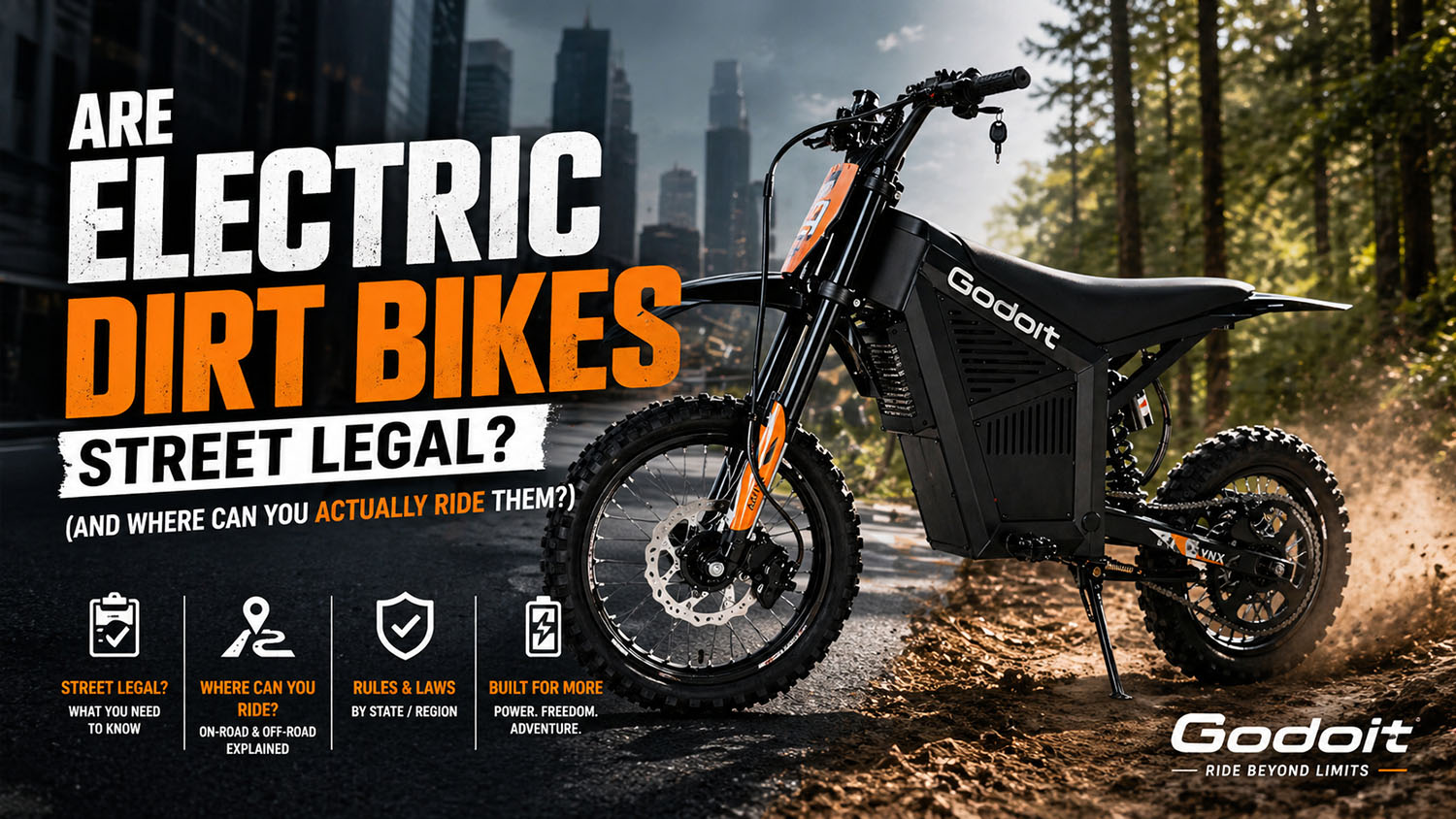
Are Electric Dirt Bikes Street Legal? The Brutal Truth About Where You Can Actually Ride
You just dropped over a thousand dollars on a brand new electric dirt bike like the GoDoIt Lynx, or maybe you emptied your savings for a high-powered Surron. You unbox it, charge the battery, and take it for a rip down your suburban street. Suddenly, you see those flashing red and blue lights in your rearview mirror. The officer steps out, looks at your bike, and asks: "Is that a bicycle or a motorcycle?"
If you don't know the exact legal answer to that question, you are at risk of a massive fine, or worse, having your brand new bike impounded on the spot.
The electric dirt bike (e-moto) industry is currently sitting in a massive legislative gray area. Technology has moved exponentially faster than the local Department of Motor Vehicles (DMV) can write laws. These bikes look like mountain bikes on steroids, but accelerate like 125cc gas motorcycles. So, what exactly are they in the eyes of the law? Can you ride them in the bike lane? Can you take them to the local mountain bike trail? Are they street legal?
In this massive, no-nonsense guide, we are cutting through the forum rumors and looking directly at US federal guidelines, state-level loopholes, and public land management rules. We will explain exactly what your e-moto is, how to keep from getting ticketed, and how to find thousands of miles of legal, epic trails right in your backyard.
Part 1: The Federal Identity Crisis – E-Bike vs. OHV
To understand where you can ride, you first have to understand what the government thinks you are riding. The biggest mistake new buyers make is assuming their 3000W electric dirt bike is legally classified as an "e-bike." It is not.
The Three-Class E-Bike System (The 750W Rule)
In the United States, the Consumer Product Safety Commission (CPSC) and the majority of state laws define an "electric bicycle" using a strict 3-Class system. To be legally considered a bicycle (meaning you can ride it in bike lanes, on sidewalks where permitted, and on standard bike paths without a license or registration), a vehicle must have fully operable pedals and its electric motor must not exceed 750 watts (1 horsepower).
- Class 1: Pedal-assist only, motor cuts off at 20 MPH.
- Class 2: Throttle-actuated (no pedaling required), motor cuts off at 20 MPH.
- Class 3: Pedal-assist only, motor cuts off at 28 MPH (often requires a helmet).
Let's look at the specs of a standard budget e-moto like the GoDoIt Lynx or a premium bike like a Talaria. They do not have pedals (they have fixed footpegs). They produce 1500W to 6000W of peak power. They exceed 20 MPH effortlessly via a throttle. Therefore, under strict legal definitions, they are explicitly excluded from being classified as e-bikes.
Enter the OHV (Off-Highway Vehicle) Classification
If it has two wheels, a motor larger than 750W, no pedals, and lacks the safety equipment required for highway use, the government classifies it as an OHV (Off-Highway Vehicle) or an ORV (Off-Road Vehicle).
Legally speaking, your electric dirt bike is treated exactly the same as a gas-powered Honda CRF250R, a Yamaha YZ125, or a Kawasaki KLR. It is a recreational vehicle designed strictly for dirt. It belongs on OHV-designated trails, private property, and sanctioned motocross tracks. Out of the box, it is 100% illegal to ride on public streets, sidewalks, or designated bicycle lanes.
Part 2: Making It "Street Legal" – The Loopholes and Gray Areas
So, out of the box, your e-moto is confined to the dirt. But what if you need to ride two miles down a public road to reach the trailhead? Can you make it street legal? The answer is a complicated "maybe," depending entirely on the state you live in.
The DOT Equipment Checklist
For a motorcycle to be street legal, it must have a VIN (Vehicle Identification Number), an MCO (Manufacturer’s Certificate of Origin), and a title. Furthermore, it must pass a safety inspection that usually requires DOT (Department of Transportation) approved equipment, including:
- DOT-approved headlights with high and low beams.
- A DOT-approved taillight and brake light (activated by both front and rear brakes).
- Front and rear turn signals.
- A horn (not a bicycle bell, an actual electronic horn).
- At least one, usually two, rearview mirrors.
- DOT-approved street or dual-sport tires (pure off-road knobbies are illegal on pavement).
- An illuminated license plate bracket.
Most e-motos do not come with this hardware. You would need to buy a third-party "street legal kit" and hardwire it into your 48V or 60V battery system.
The "Moped / Motor-Driven Cycle" Loophole
This is where the e-moto community gets incredibly creative. In many states, there is a legal category called a "Moped" or "Motor-Driven Cycle." The rules for mopeds are much looser than for full-sized motorcycles.
For example, in some states, if a vehicle has a top speed of less than 30 MPH, an automatic transmission (no clutch), and produces less than 2 to 3 brake horsepower (roughly 1500W to 2200W), it can be registered as a moped. This means you might only need a standard driver's license (no motorcycle endorsement), and you get a small moped license plate. Budget bikes with lower power outputs often slide into this category if you restrict their speed via the controller settings before going to the DMV.
The "Compliance Pedal" Phenomenon (Kaniwaba Kits)
If you've spent any time on Reddit, you've seen riders installing fake pedal kits on their e-motos (like the popular Kaniwaba kits). The thought process is: "If I put pedals on it, the cops will think it's a Class 2 E-bike."
Let's be brutally honest: This is camouflage, not legality. Bolting pedals to a 3000W motorcycle does not legally transform it into a 750W bicycle. If an officer knows the law, you will still get a ticket for operating an unregistered motor vehicle. However, in reality, many local police officers are overworked and don't care. If they see pedals, and you are riding responsibly at 15 MPH on the side of the road, they will likely ignore you. The pedal kit is essentially "cop repellent," relying on the officer's ignorance of the law. It is a massive gamble, but one that thousands of riders take every day.
The Dirt Legal / South Dakota Method
For riders who want a legitimate, bulletproof license plate without fighting their local DMV, third-party services like Dirt Legal have become massively popular. Due to reciprocal state laws, a resident of strict states like California or New York can legally register their OHV in South Dakota or Montana (states with incredibly relaxed OHV laws).
You send your bike's MCO to the agency, pay a fee, and a few weeks later, a South Dakota motorcycle license plate arrives in your mailbox. You bolt it to your bike, get insurance, and you are officially street legal. If you get pulled over, you present your registration and insurance. While some local jurisdictions are cracking down on out-of-state plates, it remains the most common way to legalize an e-moto for road use.
Part 3: Where CAN You Ride? Navigating Public Lands
Assuming you want to keep your bike purely in the dirt where it belongs, the United States is home to millions of acres of public land. But you cannot simply ride anywhere there is dirt. You need to know whose land you are on.
1. BLM Land (Bureau of Land Management)
If you live in the Western United States (Utah, Nevada, Arizona, California), BLM land is the holy grail of off-road riding. The BLM manages 245 million acres of public land. Generally speaking, OHVs are welcome on millions of miles of existing BLM dirt roads, two-track trails, and designated open riding areas (like the famous Glamis Sand Dunes or Moab).
The Rule: "Stay on existing trails." Unless an area is specifically designated as an "Open OHV Area" where you can ride cross-country, you must keep your tires on an established dirt path to protect the desert crust and vegetation. Your e-moto will require a state OHV sticker (like California's Green/Red sticker program) to legally ride here.
2. USFS (United States Forest Service) & The MVUM
The Forest Service manages the heavily wooded, mountainous regions of the country. They are much stricter than the BLM. To ride an electric dirt bike in a National Forest, you must possess a magical document called the MVUM (Motor Vehicle Use Map).
The MVUM is the absolute law of the forest. It is a map published by the USFS that specifically details which trails are open to which types of vehicles.
- Roads Open to Highway Legal Vehicles Only: You cannot ride here unless you have a license plate.
- Trails Open to Vehicles 50 Inches or Less: This is ATV and dirt bike territory. Your e-moto is perfectly legal here.
- Trails Open to Motorcycles Only: This is "Single-track" heaven. Narrow, winding trails designed specifically for two wheels. Your e-moto shines here.
Do not guess. If you are caught riding an e-moto on a hiking-only or equestrian-only trail by a Park Ranger, you will face federal fines.
3. State-Sanctioned OHV Parks
Most states have designated off-road parks funded by OHV registration fees. These are fenced-in, legally protected areas featuring motocross tracks, hill climbs, and directional trail loops. You pay a small gate fee, show your OHV sticker, and you can ride all day. Electric dirt bikes are almost universally welcomed at these parks, and many track owners love them because they don't produce the noise complaints that 4-stroke gas bikes do.
Part 4: The Great Mountain Bike Trail War
This brings us to the most controversial topic in the e-moto world: Can I ride my electric dirt bike on Mountain Bike (MTB) trails?
The short answer is: No. Absolutely not.
This is where the distinction between a Class 1 E-bike and an electric dirt bike becomes critical. Mountain bike trails are carefully built by local volunteer organizations and are designated for non-motorized use (or strictly low-power pedal-assist e-bikes).
If you take a 123-lb GoDoIt Lynx or a Surron with aggressive knobby tires onto a pristine, hand-dug mountain bike berm and twist the throttle, you will tear deep trenches into the dirt. You will destroy hundreds of hours of trail maintenance in a single afternoon. Furthermore, encountering a hiker or a cyclist while you are silently flying down a blind corner at 35 MPH is incredibly dangerous.
Mountain bikers actively despise e-moto riders who poach their trails. Taking a throttle-actuated dirt bike onto a pedal-bike trail is the fastest way to get electric dirt bikes permanently banned from your local area. Stick to motorized OHV trails. Protect the reputation of the sport.
Part 5: How to Actually Find Legal Trails Near You
Finding legal places to ride used to require going to a ranger station and studying paper maps. Today, it is incredibly easy if you use the right digital tools.
1. onX Offroad (The Gold Standard)
If you own an e-moto, you need this app on your phone. onX Offroad color-codes the entire map of the United States. It tells you exactly who owns the land (Private, State, BLM, USFS). More importantly, it highlights OHV trails in green and tells you the exact dates they are open, what types of vehicles are allowed, and links directly to the local MVUM. It takes all the guesswork out of riding.
2. Rider BDR (Backcountry Discovery Routes)
While designed mostly for larger adventure motorcycles, BDR maps are fantastic for dual-sport and street-legal e-motos. They offer thousands of miles of connected dirt roads across various states.
3. A Warning About AllTrails
Many beginners use the AllTrails app. Be very careful. AllTrails is primarily a hiking and mountain biking app. While it has an "OHV/Off-Road Driving" filter, user-submitted data is often wildly inaccurate. Just because someone rode a dirt bike there and recorded it on AllTrails does not mean it was legal.
4. Join the AMA and Local Facebook Groups
The best trails aren't always on apps; they are local secrets. Search Facebook for "[Your State] E-Moto Riders" or "[Your State] Dual Sport." Alternatively, join the American Motorcyclist Association (AMA). Local AMA chapters regularly host legal trail rides, enduro events, and maintain relationships with local landowners to secure riding access.
The Unwritten Rules of Trail Etiquette
Once you find a legal trail, keeping it legal depends entirely on how you act. E-motos have a massive advantage: they are nearly silent. This means you don't annoy surrounding neighborhoods. However, this silence can also startle people.
- Yield to Horses: This is the absolute golden rule of the trail. If you see a horseback rider, pull completely off the trail, turn off your motor, take off your helmet, and speak in a calm voice so the horse knows you are a human, not a silent predator. Do not move until they have safely passed.
- Yield to Hikers and Bicycles: Motorized vehicles always yield to non-motorized traffic. Slow down to a crawl, wave, and be polite.
- Don't Roost the Parking Lot: Don't do burnouts or tear up the grass at the trailhead staging area. It pisses off the rangers and gets gates locked.
The Final Word
Buying a budget electric dirt bike like the GoDoIt Lynx opens up a world of adventure, but it comes with the responsibility of knowing the law. Do not treat it like a bicycle. Treat it with the respect of a true motorized off-road vehicle.
Get your local OHV registration sticker, download a proper trail-mapping app like onX, stay off the pedestrian sidewalks, and keep your knobby tires on designated motorized trails. If you are willing to navigate the slight bureaucratic headache of finding legal dirt, you will be rewarded with a lifetime of adrenaline-fueled weekend adventures without ever having to look over your shoulder for flashing lights.


Share:
5 Reasons the GoDoIt Lynx Mid-Drive System Changes the Game for Budget Dirt Bikes